The following is an essay I wrote about my experiences with literacy growing up. I also address how this may affect my teaching once I have my own classroom.
When I was about six years old, I can remember my favorite book being The Baby Blue Cat Who Said No.

What’s funny is that I ended up being very much like the baby blue cat. I said no a lot and felt different from other students, much like the baby blue cat. Looking back, it’s interesting to see how my life was immersed in literacy at some points and yet I resisted participating in it at other times. If someone would have told me 10 years ago that I would be in graduate school to become a certified literacy specialist, I would have laughed and said there was nothing I would want to do any less than that. And yet here I am, writing a paper about those first 20 years of literacy experiences.
I called my mother to share with me what she could remember about my literacy experiences growing up. Prior to entering kindergarten, my mother shared that I had several toys relating to literacy. I had alphabet blocks, alphabet magnets, and a shelf full of children’s books. She couldn’t recall just how often I used these toys, but they were available to me. At some point in my early life I must have summoned some type of interest in literacy as in my elementary years I can distinctly recall playing “teacher” with my little sister and a few neighborhood friends. Though I was not very fond of reading or writing, I recall creating worksheets of simple math problems that I had learned how to solve at school. I see this now as relating to literacy because I understood that there was a purpose for writing the problems on a paper and having someone solve them. I knew that I could tell by looking at the work my sister or neighbors had done what they needed help with. But at this point in my life, my main interest, as far as school was concerned, was in math.
There are several things I can recall seeing around my house and activities we did that related to literacy. My mom was always a “list” person, so each week she would have a grocery list, a to-do list, and whatever other lists she needed to stay organized. I also recall her putting together a notebook full of plans for activities when we went on vacations. Her modeling of using writing for organization has taught me to incorporate her practices with my own mix of ideas for using writing for organization. In order for there to be lists, there must have been paper. We always had notebooks, journals, loose paper, stencils, coloring books, markers, crayons, paints, and sometimes even colored paper at our disposal. My parents would always have mine and my sisters latest work posted up on the refrigerator. Sometimes schoolwork, and sometimes it was whatever we were creating at home. I also recall a game we used to play while driving, my mom called it the “alphabet game”. The concept was simple, beginning with the letter “a”, we all searched for some environmental print with each of the letters until we got to “z”. We never kept score and I’m not sure there were any winners, but it got us looking at the print around us and realizing that words and letters are everywhere. We also would get the Highlights magazine and would read through them together and play whatever games were provided in the magazine. Which reminds me that we always had games. It wasn’t until I was a bit older that I was interested in games that had more reading tasks such as monopoly, clue, or sorry. But I see now that seeing my parents reading the instructions for any of the games we played and teaching us how to play them did expose us to one purpose for text. So far, I see several opportunities that were given to me to explore literacy early on.
I don’t recall ever really thinking of myself as a writer or even a reader prior to middle school. During that time, I began to see text as something I could use to relate my experiences to. I started collecting quotes from a website that had several themed lists of quotes and would search for quotes that I could relate to. The theme I recall searching for most often was, of course, love. Because what tween girl doesn’t have some interest or experience with love? For Christmas one year, I was given a book of colored, recycled construction paper and decided I would use it to collect quotes that I related to. I divided the colored sections into quotes that related to different parts of my life. I still have that book today. It was the first of many collections I’ve created since.
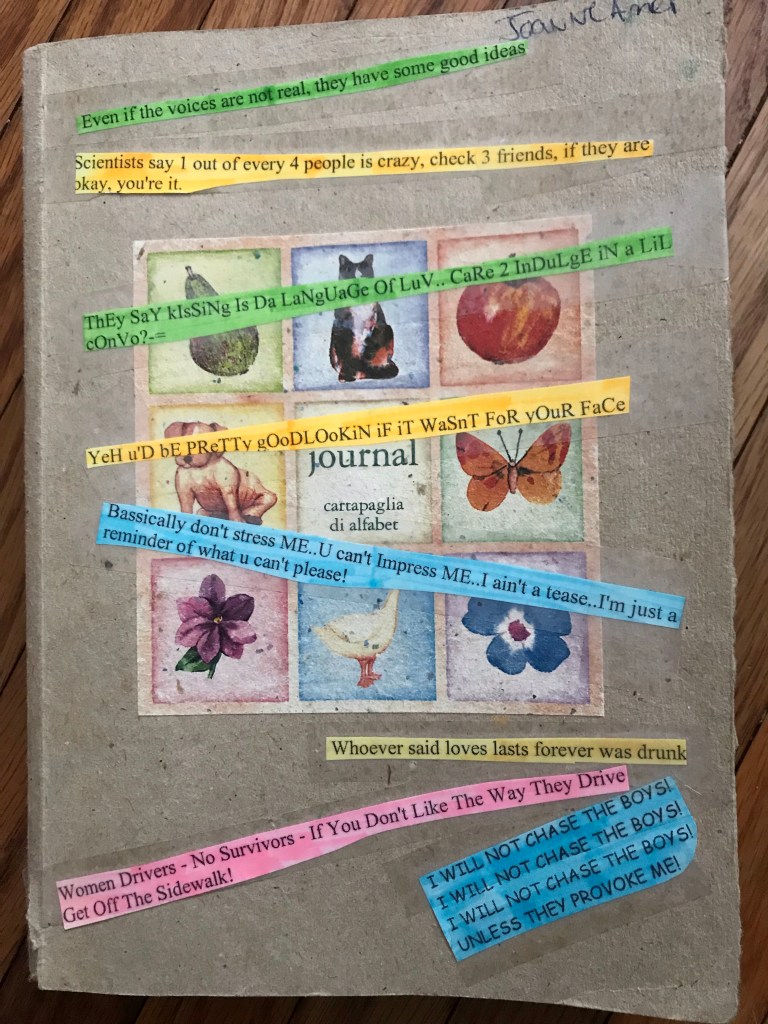
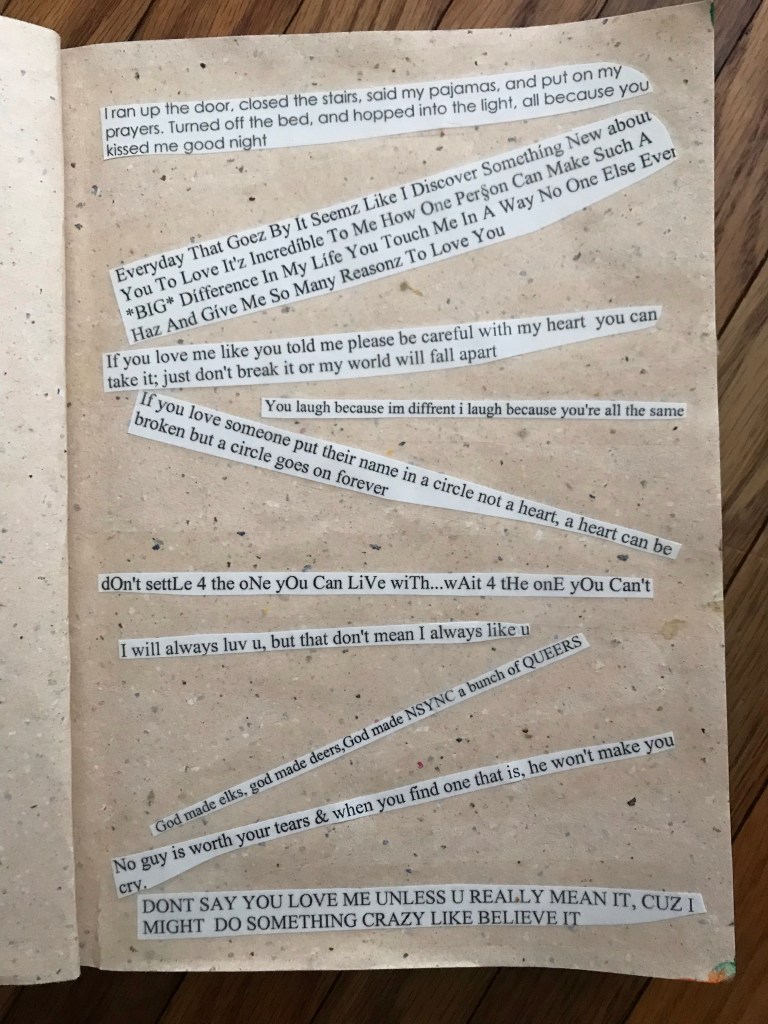

The only experiences of academic writing and reading I recall from middle and elementary school was my disdain for them. In second and third grade, I recall doing spelling tests. But the only thing that stands out from that memory is the red pen. I wasn’t a great speller early on, and the red pen marks and the poor grades didn’t foster an interest in getting any better. I also remember thinking that I was great at skimming and would skim through all the assigned reading I was given. But I always struggled with comprehension, and I can see now that I really wasn’t great at skimming at all. I also remember hearing so many rules about writing in school that made it difficult for me to feel I could write authentically. Some of the rules being: don’t say I, don’t use too many adjectives, be concise, place a reference at the end of a statement, place a reference in the middle of a statement, don’t use a reference at all, use commas, don’t use commas, etc. At that point in my life I would have rather done anything that read or write.
I did, however, write for pleasure outside of school beginning in my freshmen year. When the hormonal teenage angst took hold of me, I found writing to be an escape and relief. I remember writing notes and folding them up into small triangles and passing them on to friends between classes. I even recall creating a code with one friend so that nobody else could read what we wrote. And I wrote poetry. A lot of poetry. When I wrote poetry, I left the world of traditional literacy that I had learned about in school, or so I thought. I imposed no rules upon myself and wrote freely. I would spend hours trying to find the words that sounded just right. I would make lists of words that rhymed, and themes to write about. Once I had accumulated a sizable collection, I began transferring my work into a single book that I still have today.

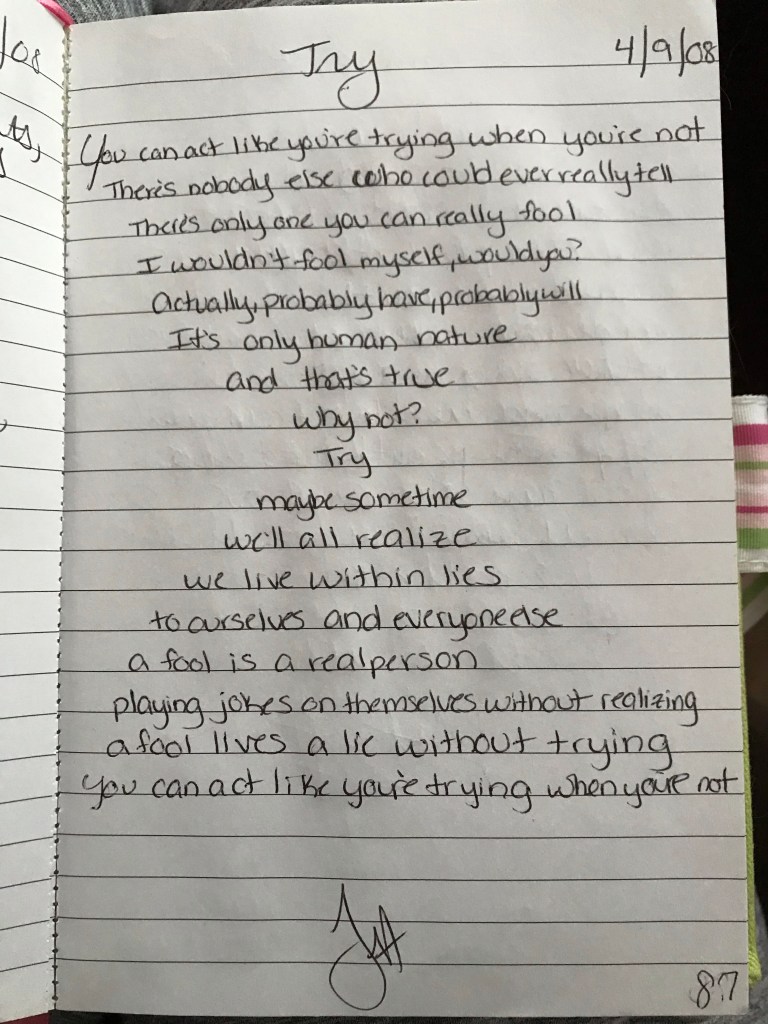
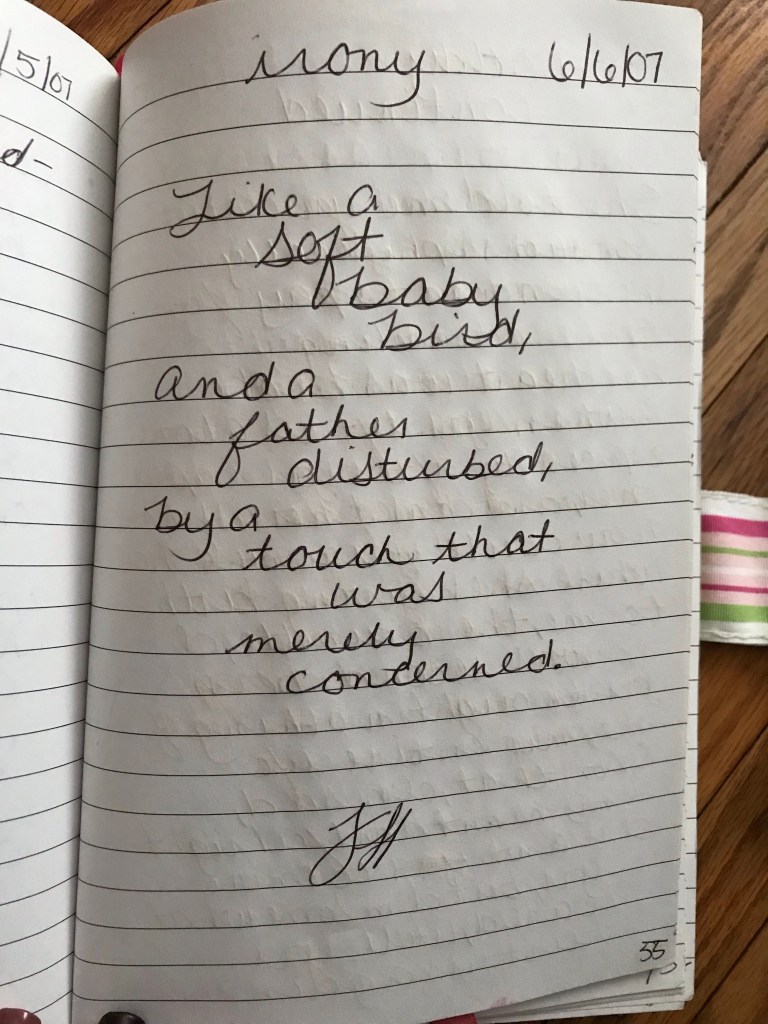
In my sophomore year of high school, I had an opportunity to take a class on poetry. I was placed in a class full of apathetic students who saw it as an “easy A”. It was clear to me that most of my classmates thought the class was a joke. I enjoyed the class though and used all that I learned to experiment in writing poetry in new formats. I recall that teacher writing “Brilliant!” on one of my poems and that stuck with me. I continued writing poetry all throughout high school.
I also had the opportunity to take a class called RIP that same year. It stood for racism, intolerism, and prejudice. The class sparked an interest in me about why some people are treated differently and I responded well to the prompts provided. It felt like I was finally taking a “real” class. Learning about things I could and would keep with me and use in the real world. Because of the positive attitude I had about the class, I wrote more and used more critical thinking than I had in many other classes.
During my senior year I found myself interested in some of the work we did in my English class. We read a play called “Twelve Angry Men”, which I’m pretty sure I kept. I think the reasons I liked it so much was that the language was easy to understand, and because we were reading it aloud as if we were the characters in the play. It may have also helped that I was the eighth juror, who is the protagonist who is attempting to change the minds of the other 11 jurors. It was an activity that made me feel involved and even important, which was not my experience throughout most of my schooling.
Later in the year in that same class, I recall the most dreadful research project I had ever conducted. Even though we could choose the topic, I seemed to choose topics that were only somewhat interesting to me. I would have never made the connection that I could choose something I had learned about in another class, like the RIP class I was so interested in. So, I chose to write about superman. Which proved to be the absolute blandest research ever. Our teacher also had us using a specific method to construct our papers. First, we found information through research the old-fashioned way. You know, using a computer program to find a book, and then finding the book in the library, and finding information in the book and taking notes on it. Then we’d write our notes or quotes on a 3 by 5 index card. After gathering information on 20 or so index cards, we were instructed to organize the cards based on the information on them. Then we wrote our essays using the information on the index cards as the general outline. I recall receiving a pretty bad grade and looking back, I see that I was resentful at the teacher for requiring us to follow a specific method and decided to basically take my outline and write the paper without really synthesizing the information I’d found. I protested her class by not participating in class, by not completing my homework, and sometimes just skipping class altogether. Of course, this didn’t benefit me or my grade and turned out to be the beginning of a spiral toward worse and worse grades.
By the end of one of the marking periods shortly after that assignment, I found out that I had a 4% average in that class. It was such a blow to my pride that instead of talking to my teacher and trying to see what I could do to turn it around, I gave up. A few weeks later I was suspended for behavior and I just never went back to my school. It would be 5 years before I gave in to the fact that I would need an education to be able to get a job that I actually liked and could succeed in.
Since I got my GED and began my college career, I’ve realized that I have great potential if I just play by the rules. But like the cat in The Baby Blue Cat Who Said No, I just had to learn the hard way.
There are so many experiences I had throughout my early literacy learning that I can turn around and use to help my own future students. I’d like to allow my students up front to share their feelings about a class. Encourage them to share why they either do or don’t want to be in a specific class. I feel that if I could have shared, or was just given the prompt to consider, my opinion and feeling going into a class may have led me to examine my beliefs about a class prior to my construction of a negative view. It might not have made me excited to write essays or read books, but it at least would have made me feel like my thoughts and feelings mattered and that they were also subject to change. I’d also love to give students opportunities to write about things that they are passionate about. Rather than allowing students to choose any topic, I’d like to provide prompts that will help them to determine topics that they are invested in and can benefit from learning about.
I also would love to try to work closely with the parents of my students to provide them with ideas and activities that they could implement at home to assist their children in developing a love for literacy activities. Looking back, I see how there were several literacy activities available to me, but I did a lot of my exploration independently. I’d like to encourage parents to stay as involved as they can in fostering a love for literacy throughout their children’s school years, rather than just in the beginning.
I most certainly will attempt to show my students how valuable reading and writing can be outside of school and in school as well. I think it was very beneficial for me to have written a lot outside of school even though I had a hard time realizing that those skills I was developing could have been used in school too. Who says you can’t write for pleasure in school? I think offering time to students 3 or more times a week to write about whatever they wanted, not for a grade, would help them to make the connection that I wasn’t able to make. I believe that school should be a place where we explore things that we’re interested in so that we have a direction to head in once we leave. Rather than being a place to fulfill a commitment we didn’t agree to that is required in order to make any choices about what we want to do next in life.
I also hope to develop good relationships with all my students, especially those that need more or different types of attention from their teachers. Even though I don’t fault my English teacher for the grade she gave me or the research assignment, I can see how I can use this experience to improve my own relationships with my students. I would like to provide my students with support and options to help them succeed before they get even close to a feeling of giving up. And I intend on using anything but red pens to provide feedback. I’d like to use markers of all different colors and quality feedback rather than just a number. I don’t ever want my students to feel like they are the numbers they see on their work. I also don’t want to give my students, at any age, strict outlines for assignments when I can avoid it. I’d really like to be flexible enough to allow my students to decide for themselves if they believe there is a better way for them to show me what they know or can do.
I suppose the main reason that my experiences will impact my teaching, is that I don’t want my students to feel like they are alone, that they can’t do what they’re being asked, or that they aren’t enough in general. These were feelings that I had during school. But like the baby blue cat, once I finally said yes, I found that I didn’t need to fight anyways as there was always a path toward success for me. And I hope I can show my students that path as well.
 Writings about Writing